The Content Pipeline: How the Linux Philosophy Can Automate Your Marketing
If you’ve spent any time in a Linux terminal, you know the beauty and power of the | (pipe) character. It embodies the philosophy that has made Linux so robust and efficient: the idea that programs should do one thing and do it well.
With the pipe, you can chain these small, specialized tools together to perform complex tasks. For example:
cat report.log | grep "ERROR" | sort | uniq | wc -lIn this command, we’re taking the output of one program (cat) and using it as the input for the next (grep), and so on. It’s a pipeline: a data source flows through a series of transformers.
But what if we applied this same philosophy to content marketing?
The “Monolithic Script” of Content Marketing
Most content creators, without realizing it, operate monolithically. The workflow looks something like this:
- Write an amazing blog post. (Great start!)
- Open Twitter and manually break down the ideas into a thread.
- Open LinkedIn and manually rewrite a professional summary of the post.
- Open a design tool and manually create an image with a powerful quote.
- …and the list goes on.
Each step is a manual, time-consuming, and disconnected process. It’s like writing a giant, complex script for every single task instead of using the efficient tools the system already provides. The result? Wasted hours and a high risk of burnout.
Building the “Content Pipeline”
Now, let’s reimagine this workflow using the Linux philosophy. Our goal is to create a pipeline where our blog post is the data source, and each social network is a transformation applied to that source.
Our ideal pipeline would look like this:
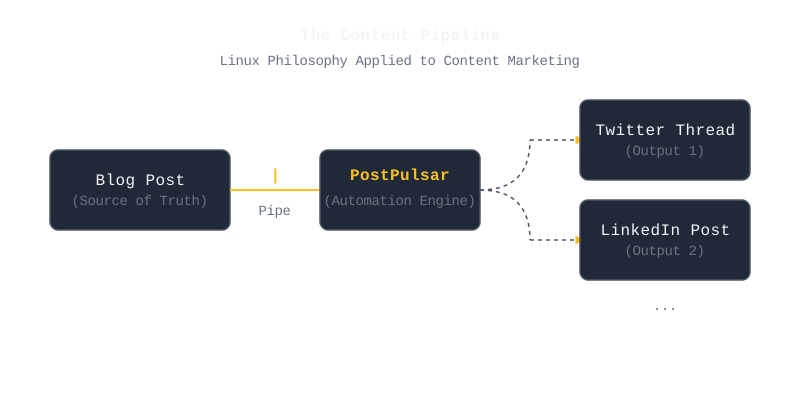
In this model:
- The Data Source (
cat report.log): This is your blog post. The single source of truth, the original, high-quality content. - The Tools (
grep,sort): These are specialized “transformers.” In our case, they are AI models trained to adapt the original content to the format and tone of each social network. One tool generates short, punchy text for Twitter; another creates a more elaborate post for LinkedIn. - The Pipe (
|): This is the automation layer that connects everything. It’s the engine that takes the data source and delivers it to each of the tools without manual intervention.
The Benefits of the Pipeline Approach
- Exponential Efficiency: Just like in Linux, you do the heavy lifting once (writing the original post). The rest is automation. The time saved isn’t linear; it grows with every new “tool” (social network) you add to your pipeline.
- Message Consistency: Since everything is derived from a single source, your core message remains cohesive across all platforms.
- Scalability: Want to start posting on Threads? You don’t have to reinvent your workflow. You just add a new “tool” (
AI to generate Threads post) to your pipeline. - Focus on What Matters: Automating the repetitive work frees you up to focus on what truly creates value: researching and writing original, high-quality content.
Putting the Philosophy into Practice
You don’t have to build this pipeline from scratch. Content automation tools like PostPulsar are the embodiment of this philosophy.
PostPulsar acts as the “pipe” and the “tools” for your marketing. You provide your blog post URL (the data source), and it automatically channels it through specialized AI models to generate optimized content for LinkedIn, Twitter, Threads, and more.
It’s the efficiency and modularity of Linux, applied directly to your growth.
Ready to turn your blog into an automated content pipeline? Try PostPulsar for free for 7 days and see the philosophy in action.